Course Overview
Course Overview
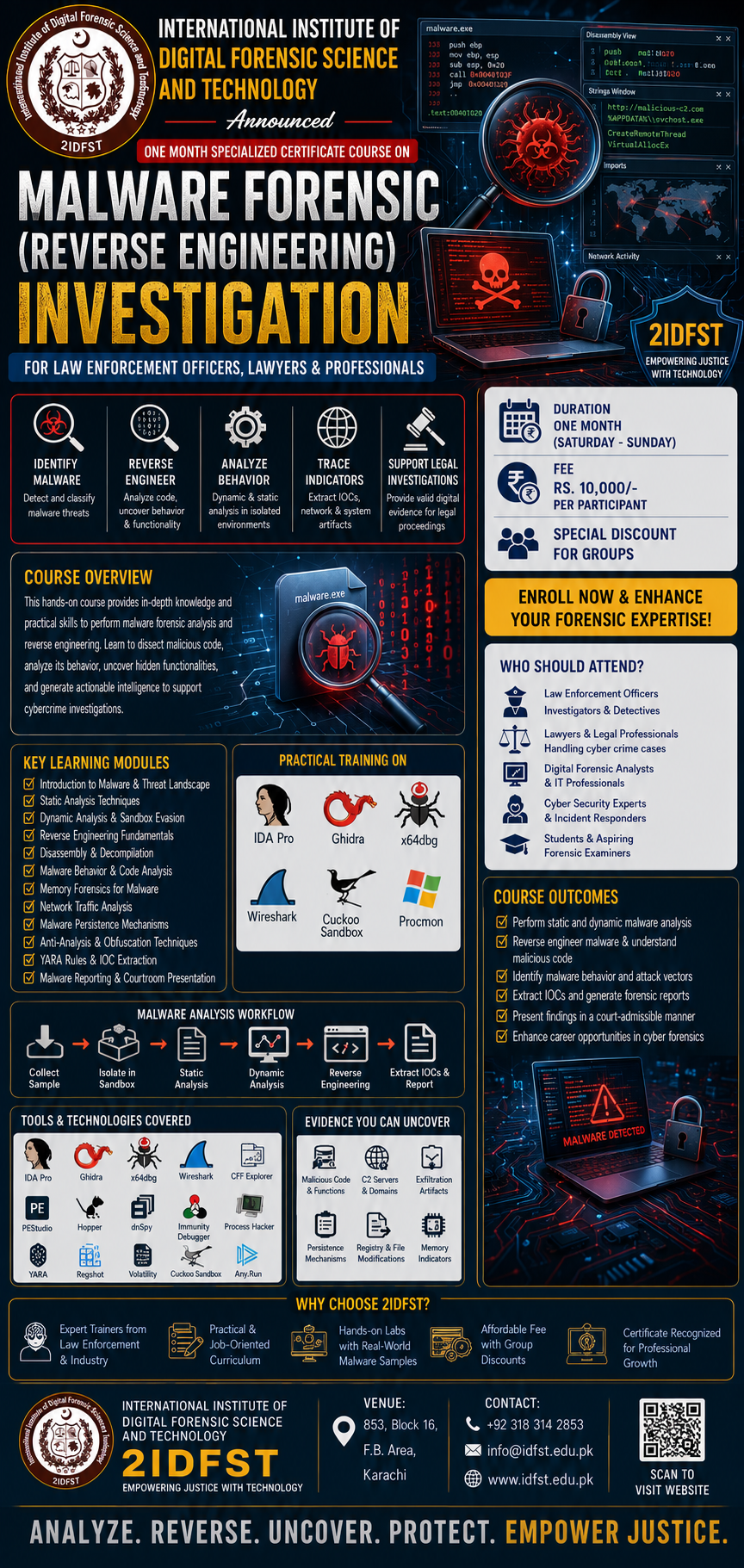
The Malware Forensic Investigation (Reverse Engineering) Certificate Course is an intensive one-month specialized training program designed to provide participants with advanced knowledge and practical skills in malware analysis, reverse engineering, and digital forensic investigations. The course focuses on understanding how malicious software operates, how cybercriminals exploit systems, and how investigators can identify, analyze, and document malware for legal, intelligence, and incident response purposes.
Participants will learn both static and dynamic malware analysis techniques, disassembly and debugging, behavioral analysis, persistence mechanisms, memory analysis, network communications, and Indicators of Compromise (IOCs). Through hands-on laboratory exercises using industry-standard tools such as IDA Pro, Ghidra, x64dbg, Wireshark, Procmon, Cuckoo Sandbox, PEStudio, Volatility, YARA, and Any.Run, learners will investigate real-world malware samples in controlled environments while following internationally accepted forensic methodologies and legal standards.
This course prepares professionals to investigate ransomware, banking trojans, spyware, rootkits, Advanced Persistent Threats (APTs), and other sophisticated cyber threats while producing forensically sound reports suitable for legal proceedings.
Modules
One Month
Who Should Attend
Who Should Attend?
This specialized course is ideal for:
Digital Forensic Investigators
Cyber Crime Investigation Officers
Law Enforcement Agencies
Intelligence & Security Professionals
Malware Analysts
Reverse Engineers
Incident Response & SOC Analysts
Cybersecurity Professionals
Ethical Hackers & Penetration Testers
Threat Intelligence Analysts
IT Security Administrators
Military & Defense Cyber Units
Legal Professionals handling cybercrime litigation
Government Investigation Agencies
Students pursuing Digital Forensics and Cybersecurity
Researchers, Faculty Members, and Academic Professionals
Anyone seeking advanced expertise in malware analysis and reverse engineering
Learning Outcomes
Learning Outcomes
Upon successful completion of this course, participants will be able to:
Understand malware architecture, lifecycle, and attack methodologies.
Perform static malware analysis without executing malicious code.
Conduct dynamic malware analysis in secure sandbox environments.
Reverse engineer malware using professional disassembly and debugging tools.
Analyze Portable Executable (PE) files and identify malicious characteristics.
Detect persistence mechanisms, registry modifications, and system alterations.
Investigate malware network communications, Command-and-Control (C2) servers, and data exfiltration techniques.
Identify and extract Indicators of Compromise (IOCs) for threat intelligence.
Analyze ransomware, spyware, trojans, worms, rootkits, and Advanced Persistent Threats (APTs).
Utilize YARA rules for malware detection and classification.
Perform memory analysis to uncover hidden malware artifacts.
Document malware functionality, attack vectors, and forensic evidence.
Prepare professional forensic reports suitable for legal proceedings and courtroom presentation.
Apply internationally recognized digital forensic and reverse engineering methodologies in cybercrime investigations.
Enhance incident response capabilities by rapidly identifying, containing, and analyzing malware infections.
Strengthen career opportunities in digital forensics, malware analysis, cyber threat intelligence, and cybersecurity operations.
Receive a Professional Certificate of Completion upon successfully meeting the course requirements.