Course Overview
Course Overview
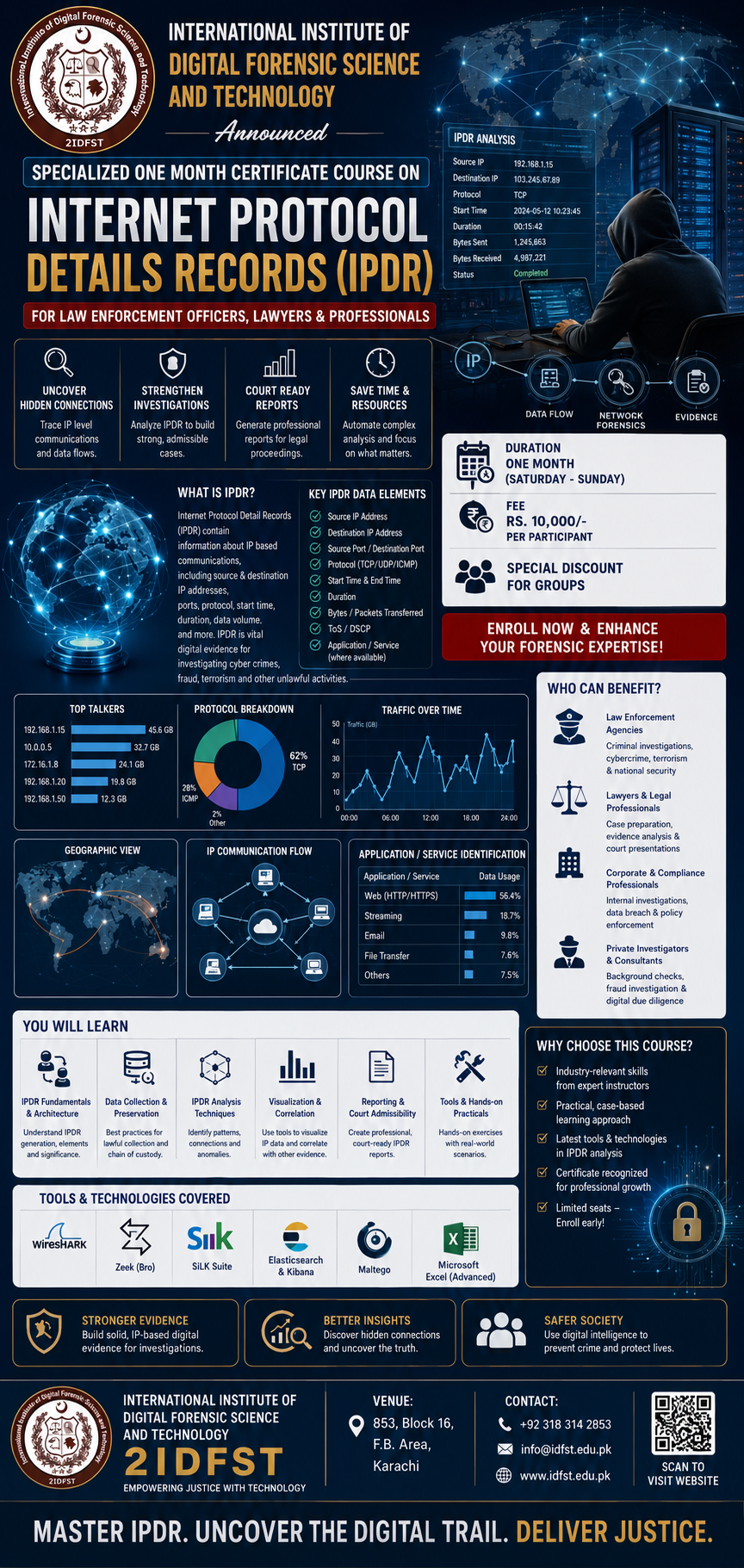
The Internet Protocol Detail Records (IPDR) Analysis & Investigation Certificate Course is an intensive one-month specialized training program designed to equip participants with the knowledge and practical skills required to collect, interpret, analyze, and present Internet Protocol Detail Records (IPDR) as digital evidence in cybercrime investigations, intelligence operations, fraud detection, and national security cases.
The course provides a comprehensive understanding of IPDR data generated by Internet Service Providers (ISPs) and telecommunication networks, enabling investigators to reconstruct internet usage, trace IP-based communications, identify user activities, establish digital timelines, and correlate network events with other digital evidence. Participants will learn how to analyze source and destination IP addresses, ports, protocols, timestamps, traffic volumes, application usage, NAT logs, geolocation data, and subscriber information using internationally accepted forensic methodologies.
Through hands-on laboratory exercises and real-world case studies, participants will develop expertise in IPDR interpretation, network correlation, visualization, reporting, and courtroom presentation using industry-standard forensic and analytical tools. The program emphasizes evidence integrity, legal compliance, chain of custody, and the preparation of professional reports suitable for law enforcement, judicial proceedings, and regulatory investigations.
Modules
One Month
Who Should Attend
Who Should Attend?
This specialized course is ideal for:
Law Enforcement Officers
Cyber Crime Investigation Units
Intelligence and National Security Agencies
Counter Terrorism Investigation Officers
Digital Forensic Investigators
Cybersecurity Professionals
Network Security Engineers
SOC (Security Operations Center) Analysts
Incident Response Teams
Internet Service Provider (ISP) Investigation Teams
Telecommunication Regulatory Authorities
Fraud Investigation Officers
Financial Crime Investigation Units
Corporate Investigation and Compliance Teams
Lawyers and Legal Professionals handling digital evidence
Government Investigation Agencies
Military and Defense Cyber Units
Students pursuing Digital Forensics, Cybersecurity, or Networking
Researchers and Academic Professionals
Anyone interested in IPDR analysis, cyber investigations, and digital intelligence
Learning Outcomes
Learning Outcomes
Upon successful completion of this course, participants will be able to:
Understand the structure, components, and significance of Internet Protocol Detail Records (IPDR).
Interpret IPDR fields including source and destination IP addresses, ports, protocols, timestamps, session duration, traffic volumes, and application data.
Collect, preserve, and analyze IPDR evidence while maintaining forensic integrity and chain of custody.
Correlate IPDR records with subscriber information, NAT logs, CDRs, network logs, and other digital evidence.
Identify communication patterns, internet usage behavior, and suspicious network activities.
Reconstruct digital timelines and trace user activities across multiple internet sessions.
Detect cybercrime indicators including unauthorized access, phishing, fraud, malware communications, data exfiltration, and command-and-control (C2) traffic.
Perform geolocation analysis and visualize communication patterns using IP intelligence and mapping techniques.
Analyze IPv4, IPv6, TCP, UDP, ICMP, DNS, HTTP/HTTPS, VPN, and other internet protocols relevant to investigations.
Utilize industry-standard tools for IPDR analysis, network traffic correlation, data visualization, and forensic reporting.
Prepare comprehensive, court-admissible forensic reports and technical findings suitable for legal proceedings.
Apply internationally recognized digital forensic standards, investigative methodologies, and legal requirements in IPDR investigations.
Support cybercrime investigations, terrorism financing cases, financial fraud, organized crime investigations, and national security operations through professional IPDR analysis.
Enhance investigative capabilities for intelligence gathering, threat hunting, cyber incident response, and digital evidence examination.
Strengthen career opportunities in digital forensics, cybercrime investigation, telecommunications, cybersecurity, intelligence analysis, and law enforcement.
Receive a Professional Certificate of Completion upon successfully meeting the course requirements.