Course Overview
Course Overview
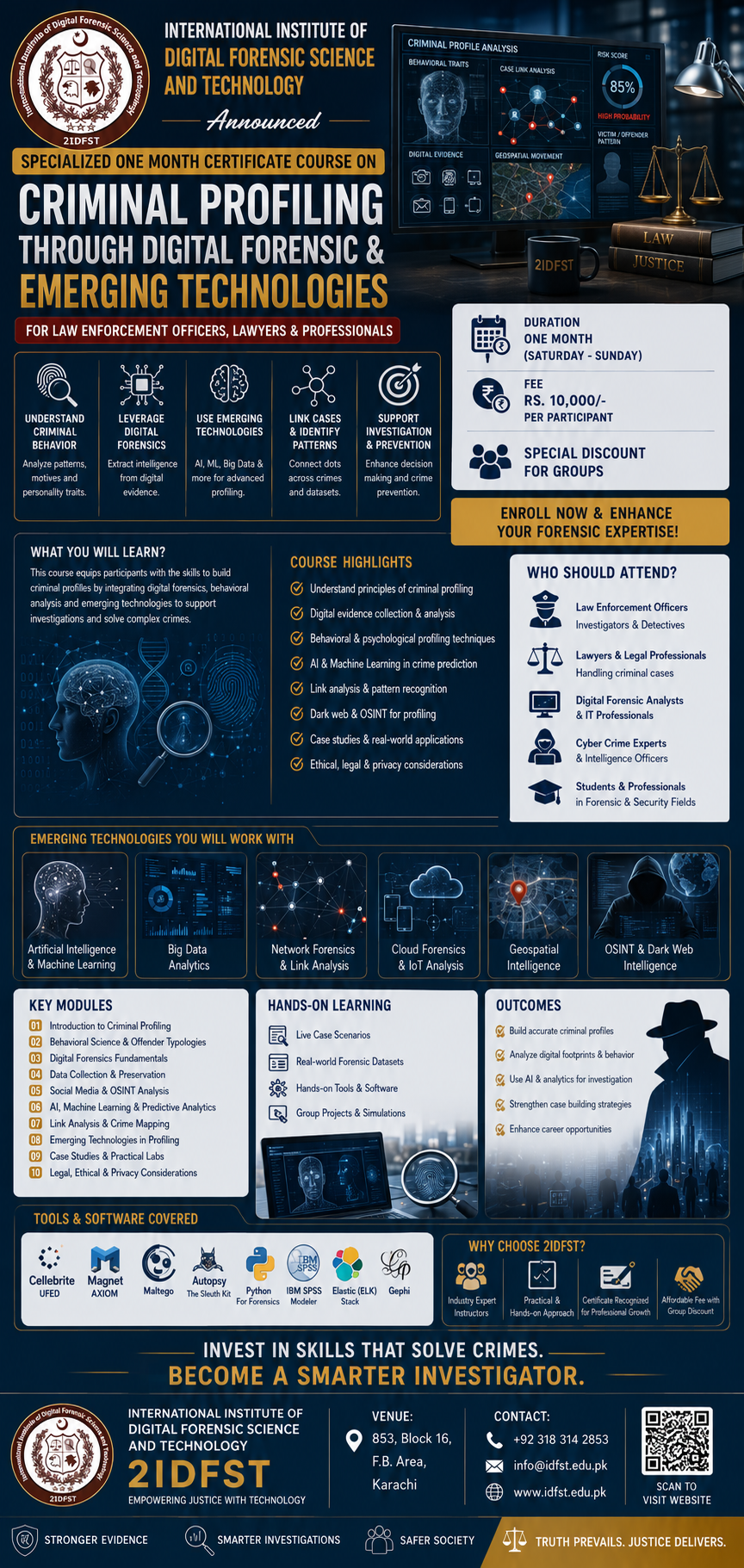
The Criminal Profiling through Digital Forensics & Emerging Technologies Certificate Course is an intensive one-month specialized training program designed to equip participants with the knowledge and practical skills required to develop criminal profiles by integrating digital forensic science, behavioral analysis, artificial intelligence (AI), open-source intelligence (OSINT), big data analytics, geospatial intelligence, and emerging investigative technologies.
The course explores how digital evidence can be used to understand offender behavior, identify patterns, reconstruct criminal activities, establish links between suspects, victims, and crime scenes, and support intelligence-led investigations. Participants will learn to analyze digital footprints from computers, mobile devices, cloud platforms, social media, networks, and online communications while applying modern analytical techniques to support criminal investigations.
Through practical exercises, real-world case studies, and hands-on use of industry-standard forensic and intelligence analysis tools, participants will develop the skills required to produce evidence-based criminal profiles, identify investigative leads, and prepare professional reports that support law enforcement operations and judicial proceedings.
Modules
One Month
Who Should Attend
Who Should Attend?
This specialized course is ideal for:
Law Enforcement Officers
Criminal Investigation Officers
Detectives and Homicide Investigators
Intelligence and Counterterrorism Personnel
Digital Forensic Investigators
Cyber Crime Investigation Units
Crime Analysts and Intelligence Analysts
Prosecutors, Lawyers, and Legal Professionals
Military and Defense Investigation Units
Anti-Corruption and Financial Crime Investigators
Security and Corporate Investigation Professionals
Behavioral Analysts and Criminal Psychology Practitioners
Cybersecurity and Threat Intelligence Professionals
Students pursuing Digital Forensics, Criminology, Criminal Justice, or Cybersecurity
Researchers and Academic Professionals
Anyone interested in criminal profiling, intelligence analysis, and modern investigative techniques
Learning Outcomes
Learning Outcomes
Upon successful completion of this course, participants will be able to:
Understand the principles, methodologies, and ethical considerations of criminal profiling.
Develop offender profiles using behavioral, psychological, and digital forensic evidence.
Analyze digital footprints from computers, mobile devices, cloud services, social media, and network environments.
Apply Artificial Intelligence (AI), Machine Learning (ML), and predictive analytics to support criminal investigations.
Conduct link analysis to identify relationships among suspects, victims, organizations, locations, and criminal networks.
Utilize Open-Source Intelligence (OSINT), social media intelligence (SOCMINT), and dark web intelligence to gather investigative leads.
Analyze geospatial and location-based data to reconstruct movements and identify crime patterns.
Correlate digital evidence from multiple sources to reconstruct criminal events and investigative timelines.
Identify criminal behavior patterns, modus operandi (MO), signatures, and indicators associated with serial and organized crimes.
Apply intelligence-led policing concepts to prioritize suspects, assess risks, and support operational decision-making.
Prepare professional criminal profiling reports and intelligence assessments suitable for law enforcement, prosecution, and judicial proceedings.
Apply internationally recognized forensic standards, investigative methodologies, and legal requirements while maintaining evidence integrity and privacy.
Strengthen investigative capabilities for cybercrime, homicide, terrorism, organized crime, financial crime, missing persons investigations, and other complex criminal cases.
Enhance career opportunities in criminal profiling, digital forensics, intelligence analysis, cybercrime investigation, law enforcement, and homeland security.
Receive a Professional Certificate of Completion upon successfully meeting the course requirements.